THEORY
MASTERCLASS
THE PHILOSOPHICAL BLACK HOLE
A conference on generative AI to be held on 16 May 2026 at the Nova cinema in Brussels.
William Henne : Good evening, everyone. Thank you for coming, and thank you to the Nova for welcoming us. Before introducing Nicolas, I’d like to point out that this discussion session has been organised by Yann Bonin, a director in the world of animation, in partnership with the Nova cinema, which also organised the first part of the event with Olivier Smolders.
Nicolas Dufresne, known as Duduf, has been living in Savoie for some time now. He’s a very versatile chap, as he’s both a teacher and a film director. He’s set up a co-operative called Rainbox Production, dedicated to animation production, as well as an association, RX Laboratori, where he develops open-source programmes. He creates all sorts of things and also writes books. He’ll no doubt be bringing us a novel one day or another.
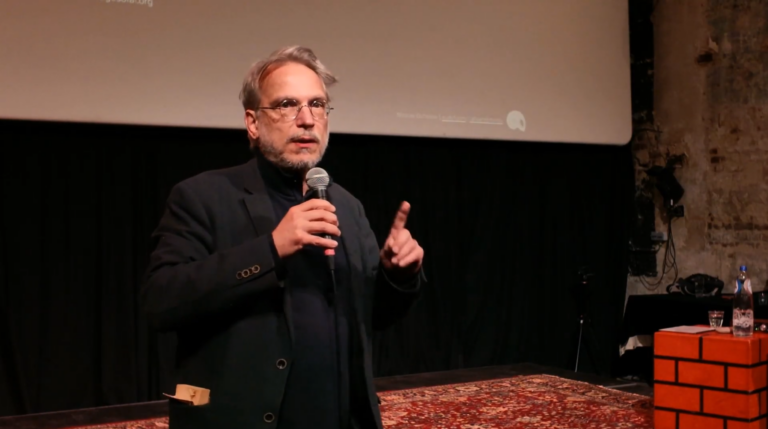
Above all – and this is the link to tonight’s event – he hosts a brilliant podcast called Une fourmi dans la coquille. The first series, available online, was devoted to artificial intelligence. The second series focuses on colour, attempting to explore all the aspects it can raise. Tonight, he’ll be talking to us more specifically about artificial intelligence, from the perspective of the philosophical black hole.
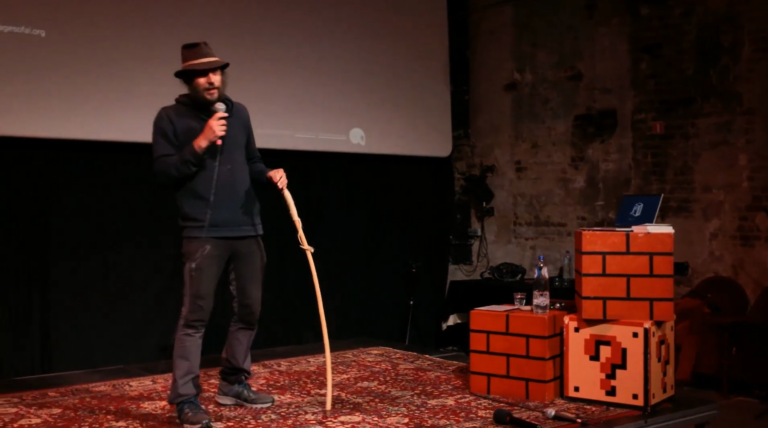
Nicolas Dufresne : Good evening. To start with, I’ve taken the opportunity to put on my Savoyard costume. I wanted to talk about hiking, but I think I’ve come to the wrong event. Never mind, I’m going to talk about it anyway, because you’ll see that the link with artificial intelligence isn’t all that unexpected. Since there’s a computer in the picture, we’ll also be talking about computing.


There’s even a photo of me on the screen, taken at home when it’s cold. It’s theatre, so I don’t know if what I’m about to tell you is true; it’s up to you to make up your own mind. Whether we’re at the cinema or the theatre, the truth isn’t necessarily our priority.
Hiking is a cornerstone of my life. It’s a time for introspection, a necessary break from the world, from schedules and time constraints. After a week alone in nature, you end up living at your own pace; that’s how I experience it, anyway. It’s an essential chance to step back from our city life. I come from the city, and I used to suffer a great deal because of it.
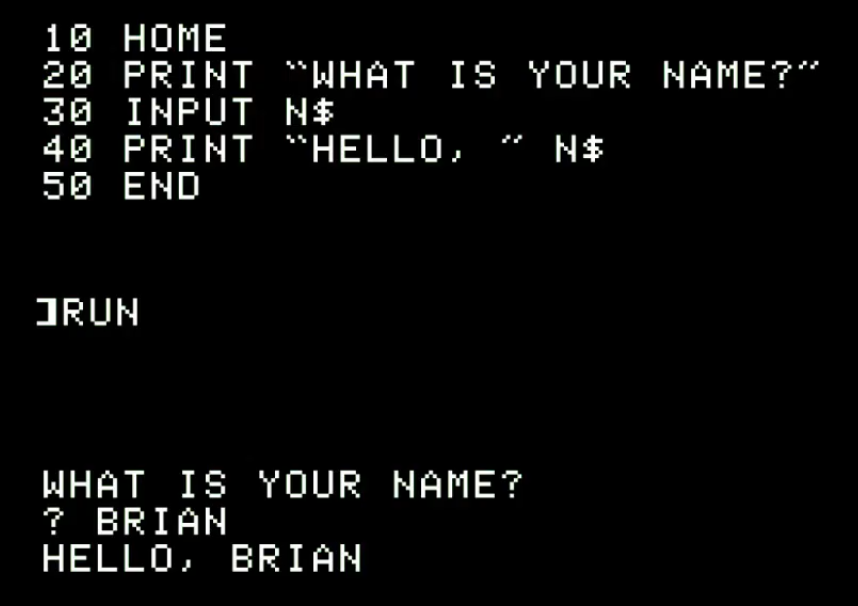
As William said, I wear many hats. Coding is one of them. My interest in computing dates back to the 1990s, when I was 12 or 13, and we got our first family computer. My older brother was passionate about computing and I was drawn right into it. From my teenage years onwards, I played around with languages like Basic, developed by Microsoft to help everyone learn to code. I created simple programmes where the computer would ask questions: ‘What’s your name?’, ‘My name is Nicolas’. The computer would reply, and I thought that was brilliant.
I soon realised there were two ways to design a conversational bot like that. Either I could analyse the syntax, grammar and vocabulary so that the programme would actually ‘understand’ the sentences — a linguistic approach that seemed too complex to me at the time — or I could anticipate everything the user might say and pre-record the responses. I decided I’d sit my mum down at the computer, tell her to try out my programme, and watch her. And every time she said something I hadn’t anticipated, I’d make a note of it and try to predict everything else she might say. I’d programme in everything—absolutely everything—that people might say to my programme, which would eventually have to find correlations and commonalities, but I’d pre-record it all. That way, it’ll be able to respond to anything we say to it. I fancied giving that a go. But then again, I realised it was going to be a right pain to do and not a very interesting job. I realised that the first method was too difficult for me, and the second was tedious and uninteresting. A few decades later, I realised that these were exactly the two approaches the early AI developers were faced with: an AI based on logical rules, or a statistical AI based on a huge amount of pre-recorded data.
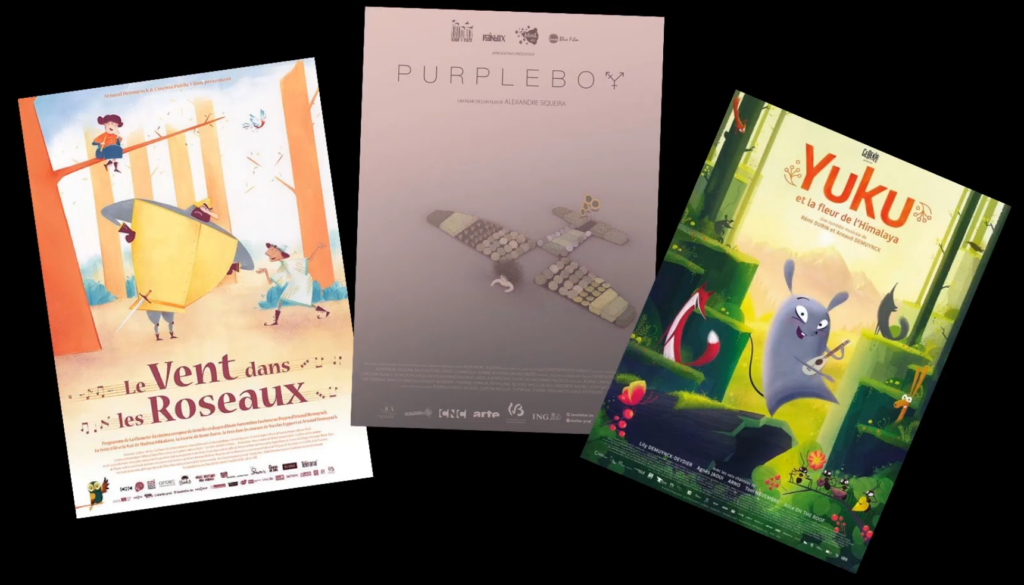
I went on to study at an engineering school, but I grew tired of it. I was more drawn to my mother’s work – she’d studied Fine Art and was an illustrator – so I decided to get into animated film. I set up a production company and directed films. I’ve chosen four examples of very artisanal films, with a warm, hand-drawn style, a far cry from cold digital animation. These are the sort of films I love to produce. I see myself more as a craftsman of animated film.
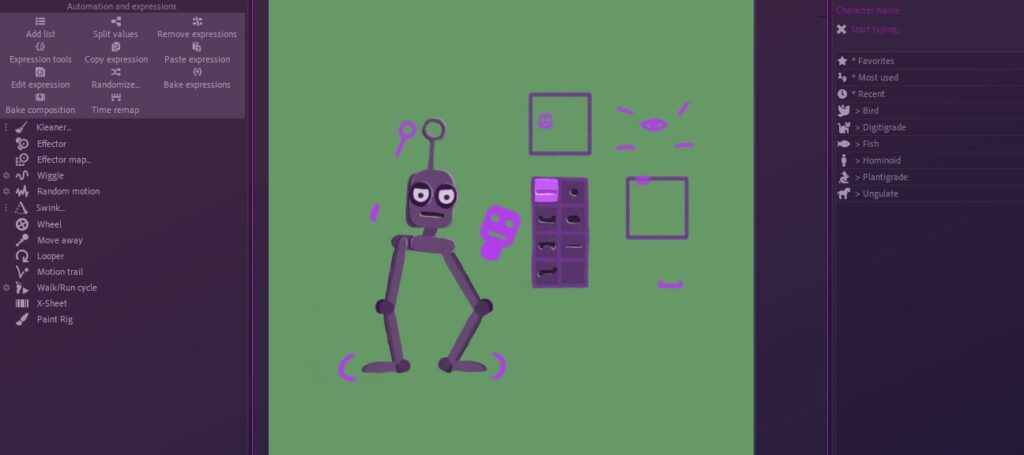
Interface of Duik Angela
Furthermore, my IT skills have enabled me to develop open-source tools for character animation. It’s a community I’ve been part of since the early days of computing: we share code, and it’s free. It’s been quite successful. These days, I juggle these two careers: film and coding. AI is, in a way, the convergence of the two. It’s not a sudden revolution – we’ve seen it coming for a long time – but the level it has reached and the way it has been marketed to us have sparked new topics of conversation.
I became fascinated by the subject, so I started reading and summarising articles for myself, to understand it. After two years, I had pages of notes on cross-cutting topics: the environment, politics, society, creativity, consciousness and the brain. I decided to do something with them. I wrote a book and, as publishing a book is a complex process, I also launched a podcast, Une fourmi dans la coquille. I spent two years thinking about AI before taking the plunge. I was worried that my ideas might become outdated, as everything moves so quickly, but there’s such a disconnect between the prevailing discourse and the reality of technological development that my work has remained entirely relevant. So, time is passing, and that’s what we’re going to talk about now. We’ve got an hour ahead of us.
Since we’re on the subject of time, I’m going to give a brief introduction that I find very interesting, to put things into perspective. Don’t worry, we’ll get round to politics later. I sensed that some of you in the room were keen to dive straight in, and we’ll get there. But we can’t tackle environmental, social, creative or political issues without laying the groundwork first. And I want to go back over all this, because it’s not something that’s just sprung up overnight.
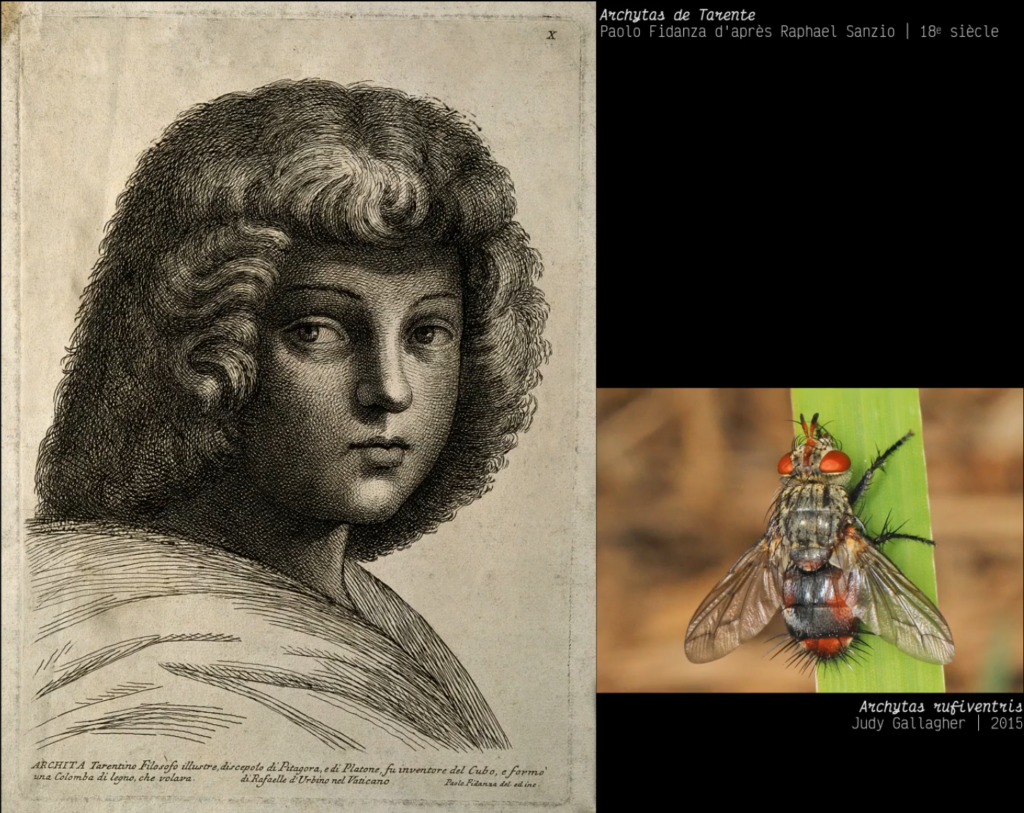
This young man you see here is a Greek philosopher called Archytas, a close friend of Plato in the 4th century BC. Archytas said: ‘It certainly seems that the art of calculation, when applied to philosophy, is far superior to the other arts, owing to its ability to deal with any problem with greater certainty than even geometry can.’ As a Pythagorean, he revered mathematics and believed that calculation enabled one to attain certainties in philosophy. At that time, the word ‘science’ did not exist; people spoke of philosophy. I find it fascinating that, as early as the 4th century BC, some people were already considering the use of mathematical calculation to construct arguments. The idea is by no means a modern one.
The image opposite depicts ‘Archytas the fly’. I discovered this entirely by chance three days ago whilst preparing for this lecture. Thanks to Wikipedia, I learnt of the existence of this fly. I should point out that I prepare my lectures without AI, as I was keen to verify the quote from Archytas myself. By carrying out this manual research, I came across a new piece of information — this fly — which I would never have found via AI, as it would simply have given me the quote I asked for.
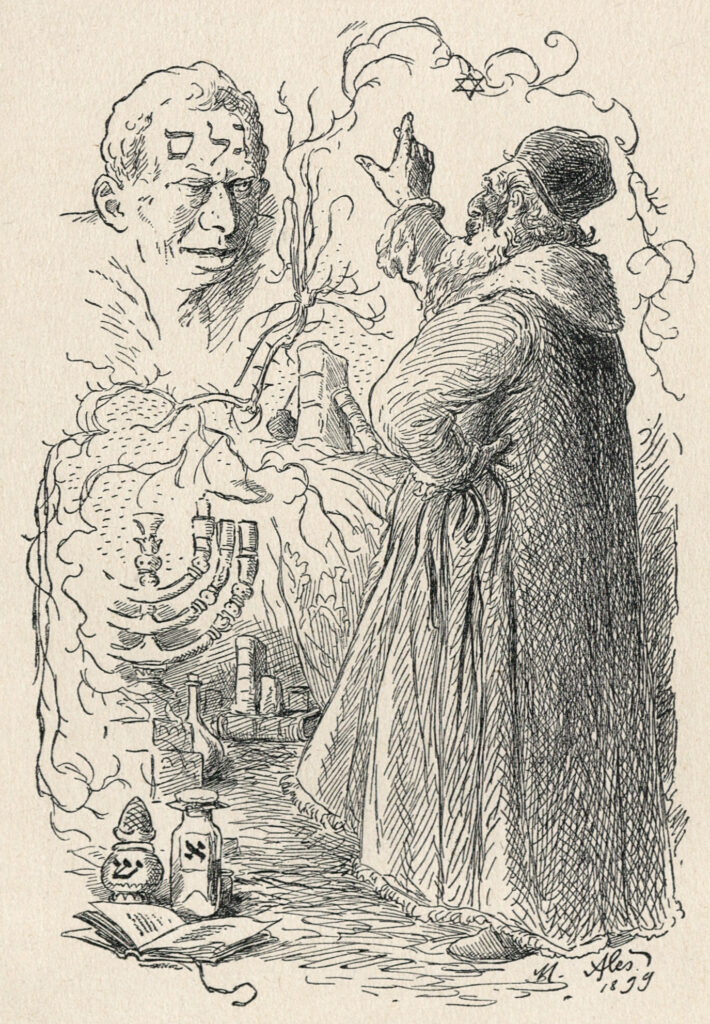
Representation of the Maharal of Prague and the Golem. Illustration by Mikoláš Aleš for a short story by Josef Svátek published in the magazine Květy (1899), National Gallery, Prague.
All this to say that the idea of an artificial being is not new; it is deeply rooted in our folklore and mythology. Think of the Golem from the early Middle Ages. What is fascinating is that the word ‘Emet’ is inscribed on its forehead, which means ‘truth’ in Hebrew. If you remove the first letter, the aleph, you are left with ‘Met’, which means ‘death’. There is, therefore, a reflection on truth and the calculation of truth. This was taken up by Raymond Lulle in 1305. He envisaged a machine with dials and levers capable of proving any philosophical truth. It is interesting to note that, from the outset, in this logical calculation, the result is often predetermined.
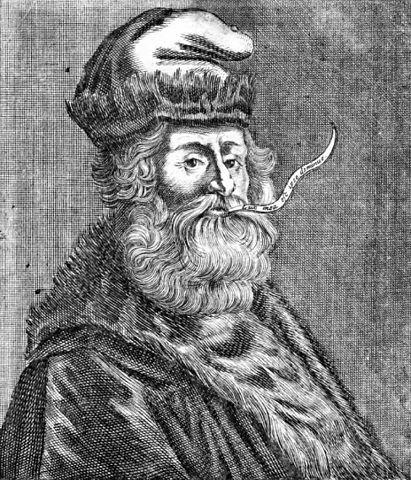
Raymond Lulle (circa 1232-1315)
In 1666, we saw the true birth of artificial intelligence with Leibniz, my idol. He theorised what he called the calculus ratiocinator; in fact, he envisaged the computer as we know it today. He took his thinking so far as to create a symbolic language — a sort of programming language — which he called the ‘universal characteristic’. This idea inspired languages that we still use in AI today, such as Prolog in the 1970s. So OpenAI isn’t really a revolution.
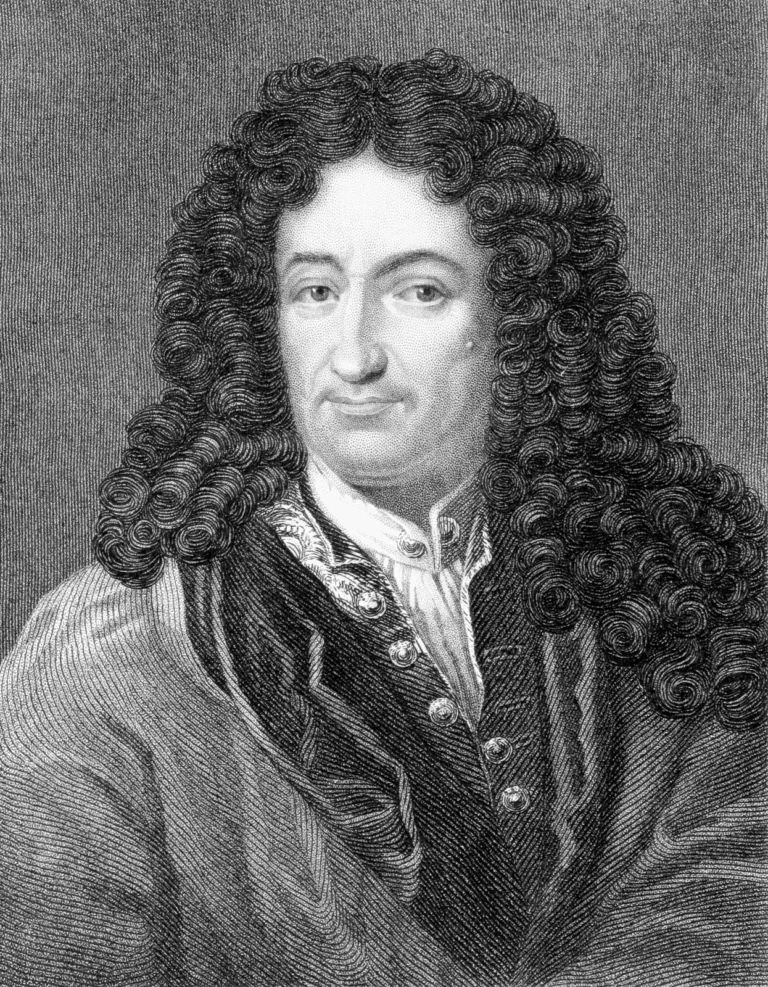
Gottfried Wilhelm Leibniz (1646-1716)
The first AI programme dates back to 1956; the Logic Theorist helped mathematicians prove theorems. The first conversational robot, meanwhile, appeared in 1966 with ELIZA. This programme simulated a psychotherapist. The key point was that the computer did not need to actually ‘understand’: it simply had to rephrase the user’s words and detect keywords such as ‘mum’ or ‘dad’ in order to ask reflective questions. The aim was to pass the ‘Turing test’. Turing, a visionary as early as the 1940s and 1950s, proposed having a human converse with a computer and another human without knowing who was who. If the human could not tell the difference, then the computer would demonstrate true intelligence. ELIZA passed this test in short conversations.
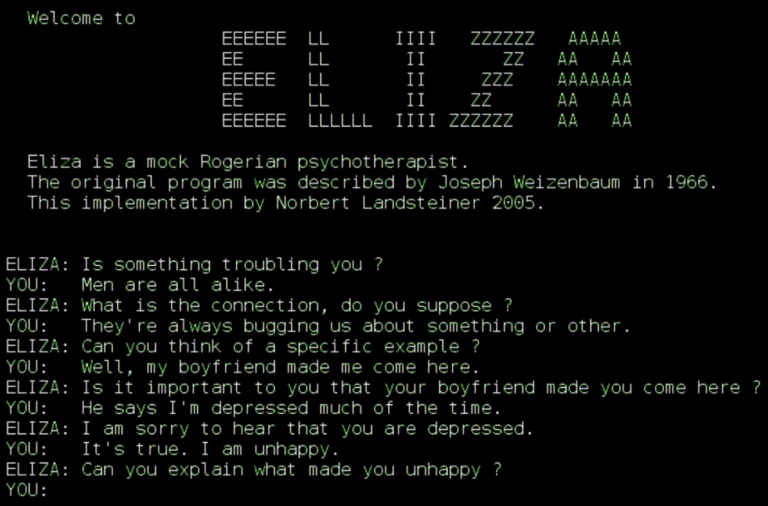
What’s interesting is that time — always time — has changed the methods. Back then, computers had very little memory, so you had to be clever and use what’s known as symbolic AI: a form of intelligence that understood rules and made predictions based on them.
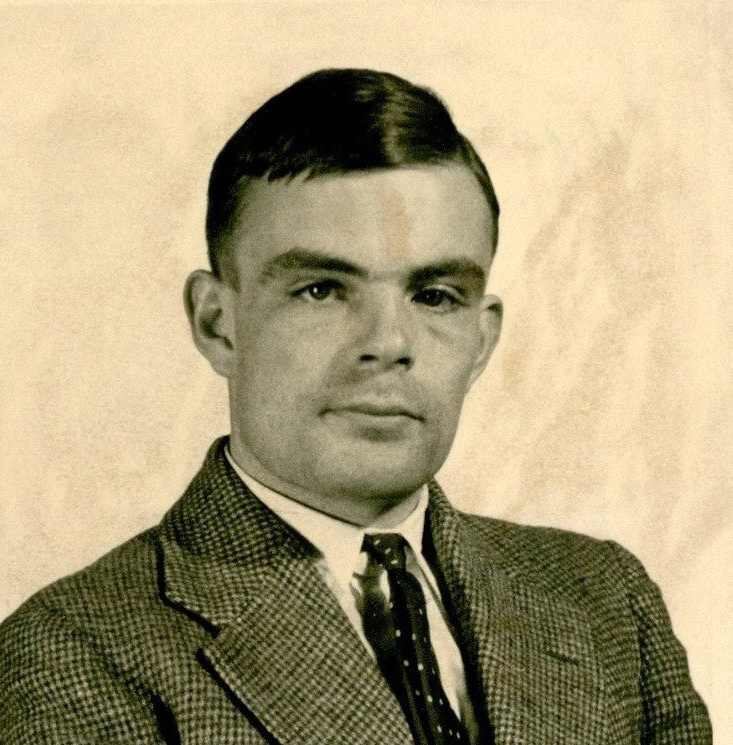
Alan Turing (1912-1954)
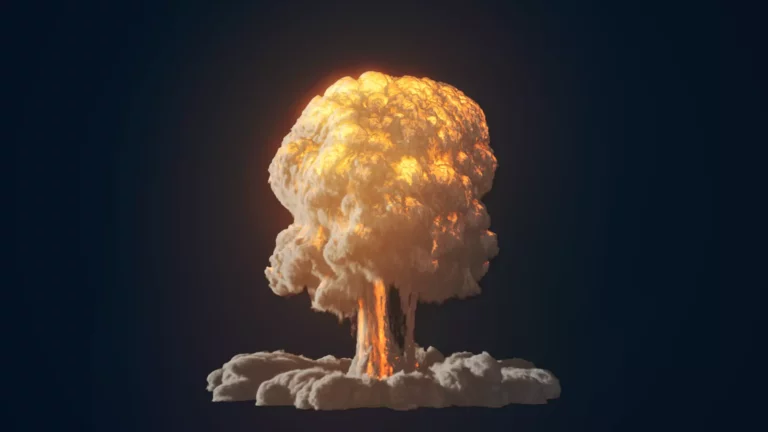
For those involved in animated film, this ties in with what are known as simulations. In film, when you want an explosion, you simulate it. You use a physics engine into which you incorporate Newton’s laws. It’s as simple as that. You tell it how gravity, air resistance and smoke behave using very complex equations. We don’t write these equations ourselves; the developers do. Once the initial conditions have been defined, we press a button and the computer applies these rules to predict what will happen. If I fire a cannonball at a wall, the computer is able to predict how the wall will shatter. These early forms of AI therefore applied rules; they contained genuine human knowledge. As a programmer and director, I think that’s brilliant, because the computer uses the laws of physics discovered by humans to produce something new.
The other approach is what is known as statistical artificial intelligence, which is based on neural networks. It’s a bit of a marketing term, as there are no neurons, nor any biology, in computers. Historically, in the 1930s, it was thought that neurons functioned like what we now call logic gates in computing. It was imagined that a neuron was an element receiving various input signals and responding with a ‘yes’ or a ‘no’. In reality, it is far more complex than that, but this belief laid the foundations. As Turing’s computers operate in the same way, using 0s and 1s, researchers very quickly thought they could recreate the brain’s functioning using digital components. Statistical artificial intelligence involves taking this logic to its logical conclusion by writing a programme that simulates this neural communication.
There was a genuine scientific ambition behind this early research: to understand how the brain works. Yet it didn’t really work. Why? Because the human brain has 86 billion neurons, which we were unable to simulate at the time. We could get about fifteen of them to function, but no more. The artificial neuron of the time was called the ‘perceptron’. This method fell somewhat out of favour before coming back into vogue in the 1990s, when the combination of the two approaches
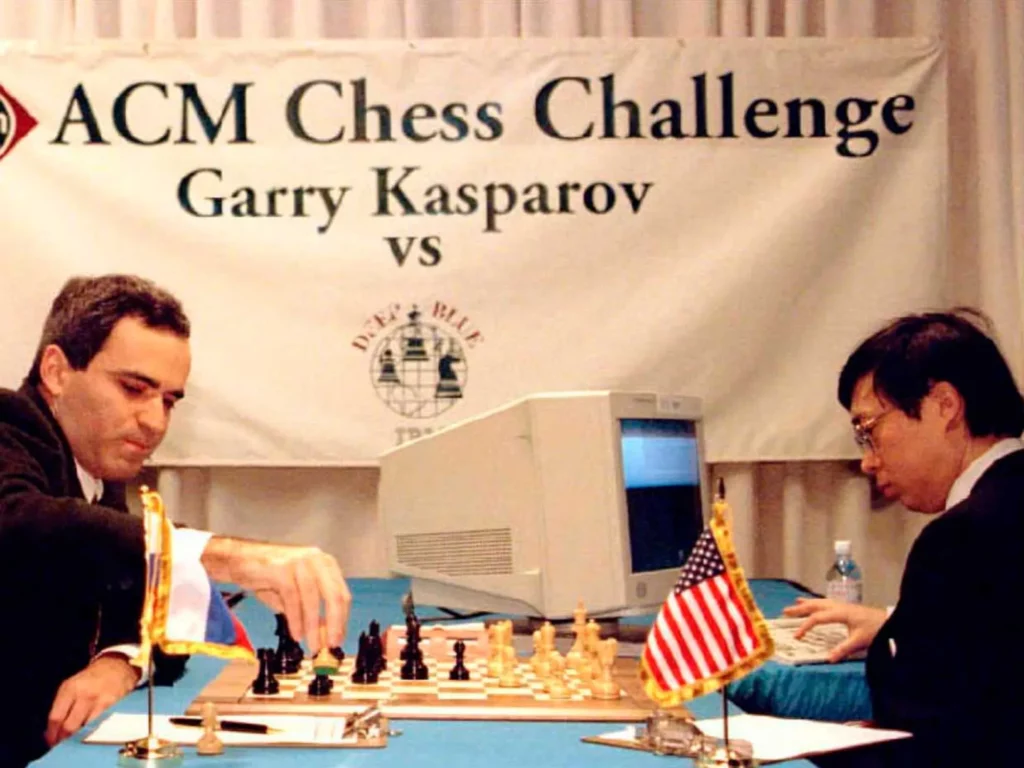
It wasn’t until the 2010s that two conditions were met: high-speed internet to collect massive amounts of data, and the computing power needed to process it. It was students, who were keen fans of video games such as Counter-Strike, who came up with the idea of using graphics processing units (GPUs). They realised that neural networks worked in the same way as graphics cards calculate pixels on screen. They tried it out with a project called AlexNet, and it worked very well.
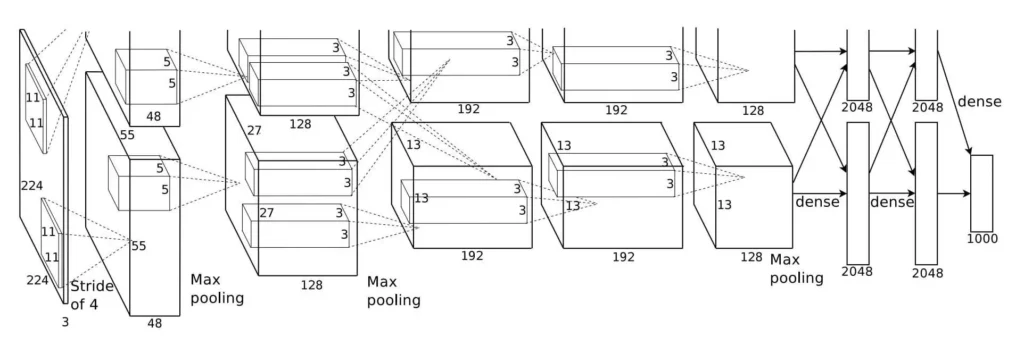
AlexNet est un modèle de classification d’images qui a transformé l’apprentissage profond. Il a été introduit par Geoffrey Hinton et son équipe en 2012 et a marqué un événement clé dans l’histoire de l’apprentissage profond, mettant en valeur les atouts des architectures CNN et ses vastes applications.
It took ten years of development, particularly at Google, to work on the two pillars of AI: image analysis – often funded by the US military for espionage purposes – and language analysis. Following this breakthrough in the 2010s, we have now reached the launch of ChatGPT by OpenAI. What is fascinating – and I’ll leave it at that regarding the history of AI – is that virtually all the techniques and innovations used today had already been scientifically theorised as far back as the 1960s.
The only thing that was new was the scale – that is, the ability of certain companies to build ever-larger systems. It worked very well, and we have forgotten about so-called ‘symbolic’ artificial intelligence – the kind I was talking about, which understands rules and is intellectually stimulating – in favour of this approach, which I find fundamentally lacking. Hoarding a huge amount of data is a crude method; it works, of course, but it teaches us nothing. As a programmer, I find that a shame. There’s a trend to claim that everything must be open source because it’s ‘brilliant’. But why should it be? AI code teaches me nothing: it’s been around since the 1960s and is based solely on optimisation. It’s interesting to see how engineers have optimised these systems, even if that goes beyond my area of expertise, but the way in which an AI generates language remains a black box. It’s purely statistical; there are no linguistic rules governing how ChatGPT works. This AI can’t teach us anything about language, even though it’s very adept at manipulating it.

It is precisely because this system operates on a different scale that it raises all the current issues. Everything digital has an environmental impact, something we tend to forget because we believe it all happens in the ‘cloud’. But digital technology isn’t in the clouds; it’s in the mines. It’s metal, plastic and oil – it’s extremely tangible. It’s electricity in wires and photons in optical fibres that need to be produced. Artificial intelligence replicates these very same problems, but on an absurdly larger scale.
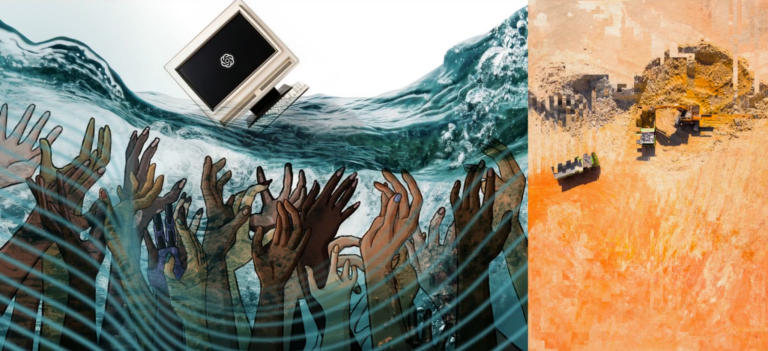
A rising tide lifts all bots (Rose Willis & Kathryn Conrad – betterimagesofai.org)
Distorted sand mine (Lone Thomasky & Bits&Baüme – betterimagesofai.org)
When we talk about catastrophic environmental impact, we need to be precise about the figures. Let’s take the example of a proposed AI data centre in France, with an estimated cost of 50 billion euros. This centre is expected to consume 1.4 gigawatts of electricity – equivalent to the output of a single nuclear reactor. There are currently between 400 and 500 data centre projects in France. If we want to move away from oil by electrifying our cars, we will have to make choices: we will not be able to power ChatGPT, image generators and electric cars all at the same time.

Le data center de Digital Realty à la Courneuve (photo : Digital realty).
The problem is that the electricity grid isn’t ready. As it takes years to build a nuclear reactor, the data centres being built today are often powered by natural gas turbines. Microsoft has, in fact, signed a contract to reopen the Three Mile Island nuclear reactor – the site of one of the most serious nuclear disasters in the US – because new power stations cannot be built quickly enough to meet demand. The environmental disaster is therefore not an abstraction or a mere opinion; it is an immediate, tangible reality. I’m sorry to sound so gloomy; I didn’t mean to get you down.
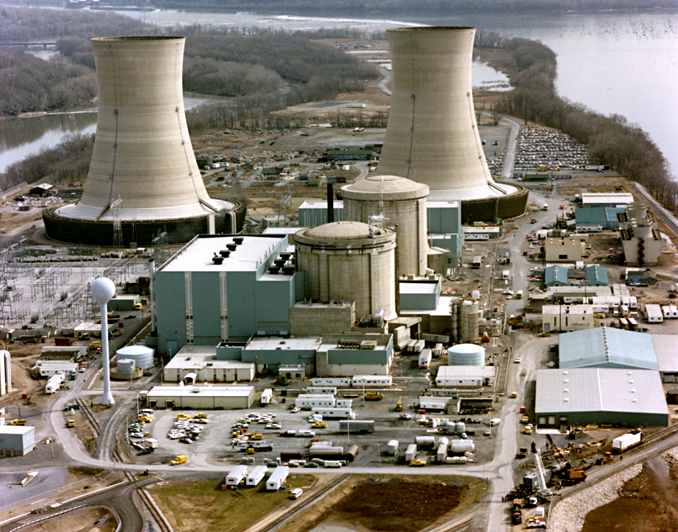
Three Mile Island nuclear power station, circa 1979. The Three Mile Island accident was caused by a partial meltdown of the core of reactor No. 2 (TMI-2) at the Three Mile Island nuclear power station, situated on the Susquehanna River in Londonderry Township, Dauphin County, near Harrisburg, Pennsylvania (photo: US Department of Energy).
The problem with these AI companies is that they know they are unprofitable, but they do not want to disappear because they wield immense power. They are funded by capital, not by profitability. Investors buy their shares in the hope of capital gains, which drives these companies to put on a show to make themselves indispensable for as long as possible, before reality catches up with fiction. To this end, they invest in sectors where they become indispensable, such as defence. They have contracts with all the armed forces, including Mistral in Europe: their systems are integrated into fighter jets and missiles. If they were to go under, the state would be forced to bail them out, as it needs to maintain control over its own armaments.
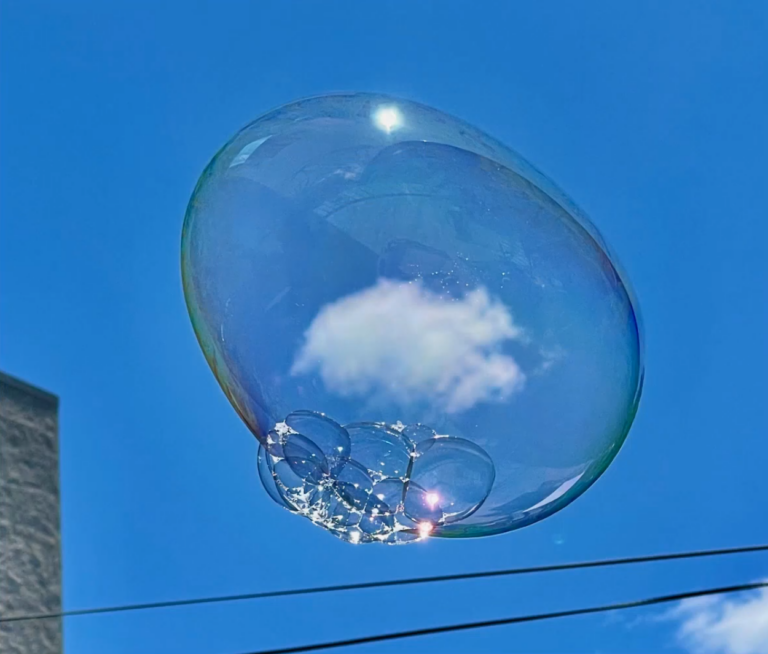
Soap bubble and a cloud (Oleg Yunakov, 2022)
The problem with these AI companies is that they know they are not profitable, but they do not want to disappear because they wield immense power. They are funded by capital, not by profitability. Investors buy their shares in the hope of capital gains, which drives these companies to put on a show to make themselves indispensable for as long as possible, before reality catches up with fiction. To this end, they invest in sectors where they become indispensable, such as defence. They have contracts with all the armed forces, including those in Europe: their systems are integrated into fighter jets and missiles. If they were to go under, the state would be forced to bail them out, as it needs to maintain control over its own armaments.

The enchanted merry-go-round of artificial intelligence: Lordon describes the mechanics with clinical precision. OpenAI has secured a $122 billion funding round, $50 billion of which was committed by Amazon. In return, OpenAI has committed to $100 billion worth of orders from Amazon Web Services. OpenAI and AWS place massive orders for chips with Nvidia, which in turn invests 30 billion in OpenAI’s funding round. This is not a Ponzi scheme, but an ouroboros: the serpent biting its own tail. And for the circle to hold, there must be no breaks. Yet OpenAI has still not made a single dollar. The company lost between six and eight billion last year, plans to spend 600 billion by 2030, and is asking the public to believe that by then, profits will materialise. An analyst note from HSBC, on the other hand, estimates that there will still be a cumulative shortfall of 200 billion dollars to fill, which will require ‘a major refinancing fix’. Major investors are sending out signals. Warren Buffett has methodically liquidated all his holdings over the past eighteen months and is sitting on 325 billion in cash, ‘completely safe’. Peter Thiel has sold off his Nvidia shares, and Michael Burry has taken out put options on Nvidia to bet that it will ‘crash and burn’ (source: Elucid).
The final aspect I’ve been working on is the social impact. Beyond the loss of jobs for coders in Europe, there is a far bleaker reality. Take, for example, an AI designed to recognise cats in images. The human brain is fascinating: a child only needs to see a few examples to identify a cat, whereas an AI requires millions of images.

These images must be sorted, extracted and prepared by humans. It is estimated that there are between 150 and 400 million of these ‘click workers’ worldwide. These are people who carry out micro-tasks, often for low pay, to continuously train the systems.
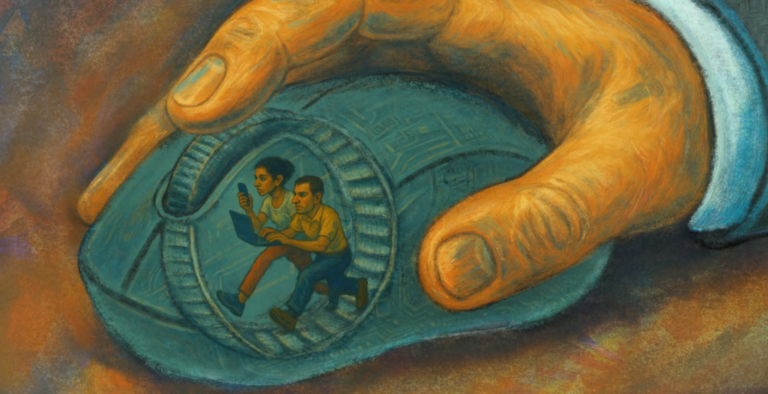
Wheel of progress (Leo Lau & Digit – betterimagesofai.org)
Sometimes, it goes much further than that. In a report entitled ‘Will AI Kill the Internet?’, we saw a woman in an African country – who didn’t even know which company she was working for – who had to trace wounds on corpses to teach an AI to distinguish between gunshot and stab wounds. Every AI application relies, at some point, on a human doing the work in its place. This isn’t a reduction in work; it’s a shift of that work to where it is cheaper and better hidden.
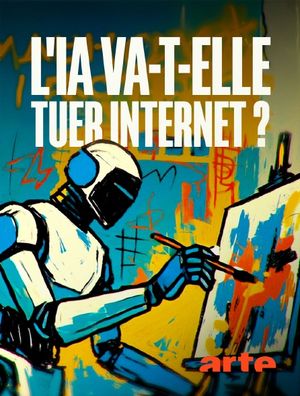
That doesn’t mean, however, that we should throw everything away. Making a medical diagnosis isn’t daft, but we need to weigh up the benefits against the risks. Is it worth it just to make a TikTok video? The question is what we consider useful in our society – and at what cost. It’s a question of production, a societal issue that goes far beyond the scope of AI. Right, I’ve finished the introduction.
To get back to my line of work, once these questions of impact had been raised and understood, I said to myself: ‘All right, AI is here’. There’s a fatalistic view that claims we have no choice, as it’s being imposed by the GAFAM. At one point, I felt like saying that this might be the only time in my life I’ve seen a catastrophic phenomenon on the horizon — although we need to put it into perspective, as everything is relative when compared to air pollution, for example. I wish I’d been around when we could have fought against the advent of the car – which is a dream for me, living in the mountains and owning neither a car nor a driving licence. I’m here to witness the arrival of AI, and I felt a surge of rebellion: ‘Let’s go for it! Let’s say no; for once, we’ll manage to stand up to progress.’ But I think it’s already too late. I have a glimmer of hope that the economic bubble might rid us of it to some extent, but we’re going to have to live with it.
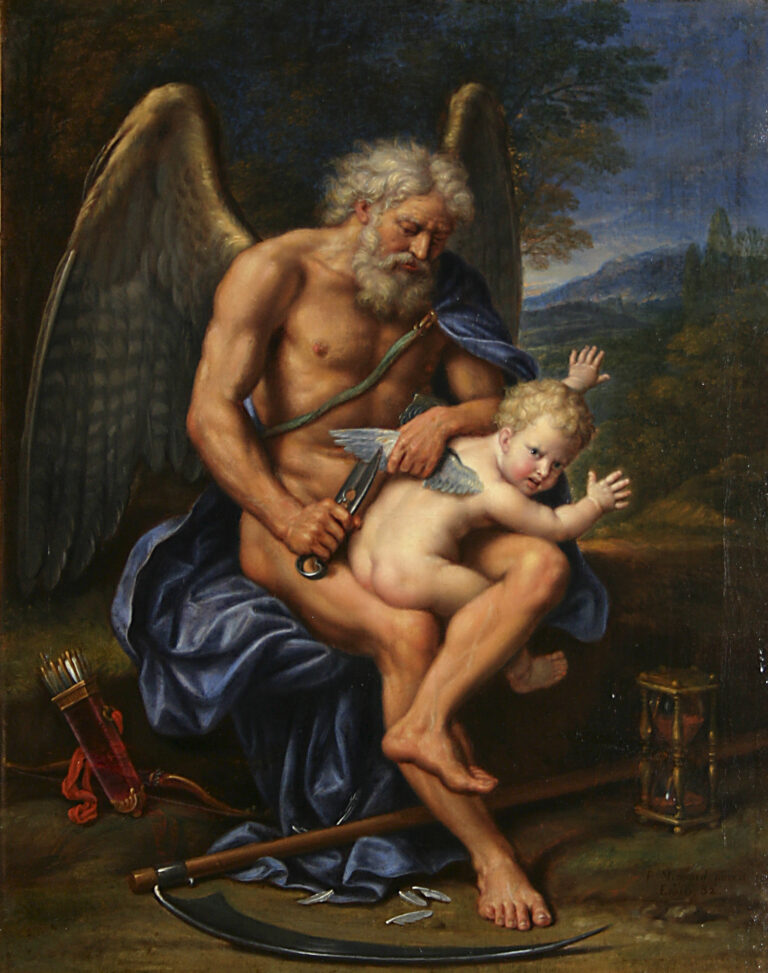
Chronos cutting off Cupid’s wings (Pierre Mignard, 1694)
It is interesting to consider how this affects my work as a creator and director, whether in advertising or visual production. I included a scene showing Chronos cutting off Cupid’s wings, because I am talking about time, and the main selling point of AI is that it saves time. However, I’m not talking about arthouse films, but about the purpose for which AI was designed. The developers of these systems see art as a flaw, just as they regard my presentation this evening as a flaw; they’d probably prefer me to keep quiet. AI should not be a tool I have to fight against, just as I do not fight against my paintbrush. The paintbrush has its limitations, but I am aware of them and I am the one who decides. AI, on the other hand, tries to prevent me from doing my job.
The demand to work faster, to produce ever more, is entirely incompatible with artistic creation. The philosopher Ivan Illich, who observed the advent of the car, theorised the ‘radical monopoly of machines’. He explained that the tool eventually comes to dominate the individual and bind them to the social body: whilst a tool should be emancipatory and promote autonomy, it becomes counterproductive when it achieves such a monopoly that we no longer have a choice. His example was the car: its widespread adoption led to the construction of motorways, which ultimately prevented us from travelling by any means other than by car. He also calculated that if we include
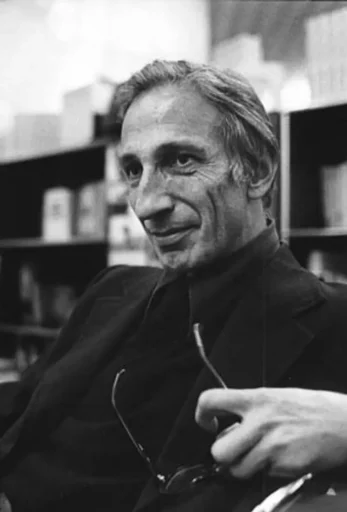
Ivan Illich (1926-2002)
During my hike, I climbed Le Brévent, facing Mont Blanc. After a gruelling ascent, I reached the summit and found a tourist in flip-flops eating an ice cream, who’d arrived by cable car. It reminded me of the feeling I get when I see my nephew creating Ghibli-style images with just two clicks. It’s the same disconnect: he took his Instagram photo and left, whereas my memory of the climb is deeply ingrained because the ‘act of doing’ takes precedence over the destination. You shouldn’t write a novel because you picture yourself holding the finished product, but because you want to write. If you use AI to bypass the process, the result is meaningless. Time doesn’t just allow for quality; it is quality itself.

Der Wanderer über dem Nebelmeer (Caspar David Friedrich, 1818, Hamburger Kunsthalle, Hamburg)
Finally, time allows for quality. When you take that away, you don’t see things through to the end. Unless I’m boring you, just let me know. I fancy pottering about; I’ve got loads to tell you and, in fact, time is the one and only argument in favour of AI: it’ll make things go faster. I want to emphasise this point. I don’t think AI is capable of doing anything else. Let me come back to the artistic side for a moment. Here’s Turner, a 19th-century Romantic painter whom I adore.

Fishermen at sea (Joseph Mallord William Turner, 1796)
Edmund Burke, an Enlightenment philosopher, explored the concepts of beauty and the sublime. He conceptualised the sublime, which lies beyond beauty. The sublime is what one feels when faced with the immensity of a mountain or a raging sea. It is what humans feel when confronted with incredible beauty mixed with mortal danger. When will an AI be able to understand this sort of concept? It’s impossible. AI cannot be used for that.
So I wonder whether it’s worth the effort, given all its implications. If it were capable of creating the sublime, then perhaps we could have a discussion. We could say that it enables us to achieve astonishing things, works that will stand the test of time. But we all agree that it won’t be able to do that. If it’s incapable of doing so, is it worth the effort?
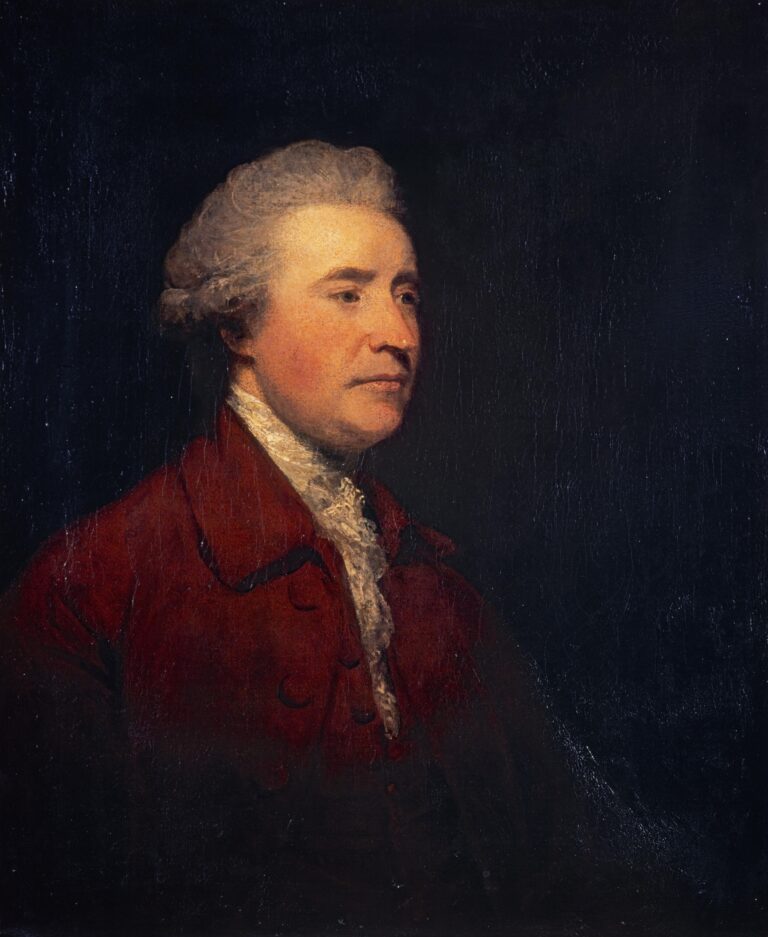
Edmund Burke (1729- 1797)
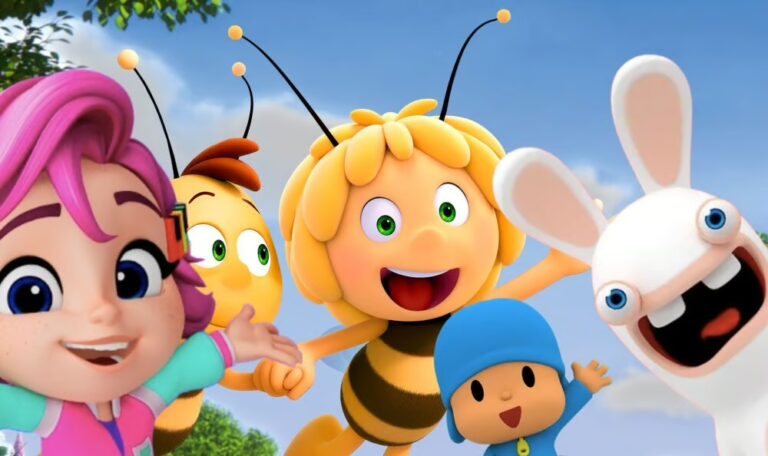
I’ll take the example of advertising or children’s cartoons, because AI is sneaking in through the back door, where there’s no budget. That’s how I see it. Animaj, a company founded in 2022, has bought the rights to Maya the Bee and Pocoyo to release one AI-generated episode a day on YouTube for children. We tolerate it because it’s for children – it’s not for adults yet – but that’s the way it’s coming. Not only do I question the value of this, but it’s also taking hold in advertising.
A friend who works in advertising sent me a photo from a construction company in an Arab country. I’ve blurred the faces and logos for privacy reasons, but I should point out that these are Arab people. The company needed to convert the photo to a portrait format and used AI to generate the missing parts. That’s the easiest way to do it these days with Photoshop: you click, and ask it to fill in the gaps.

Here’s the result, and it’s a problem. That was the first generation to come out, I promise you.
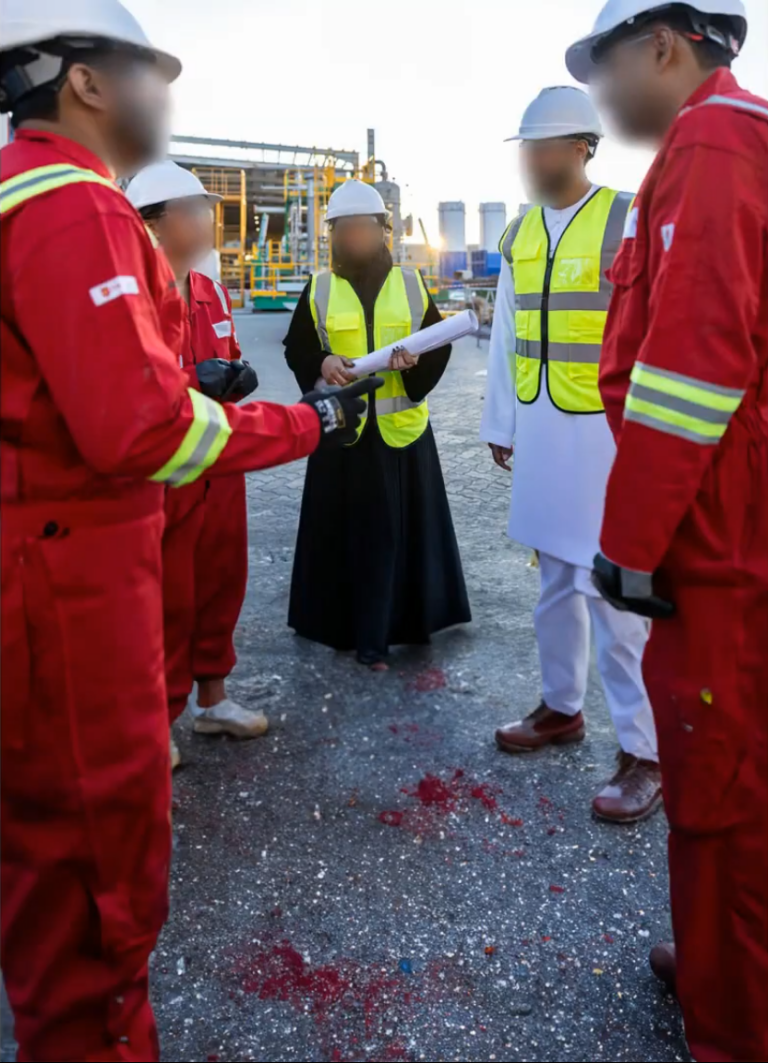
In other test shots, misshapen feet were found – the very same flaws that can be seen in Olivier Smolders’ film. This is the only version in which the legs appeared to be correct.
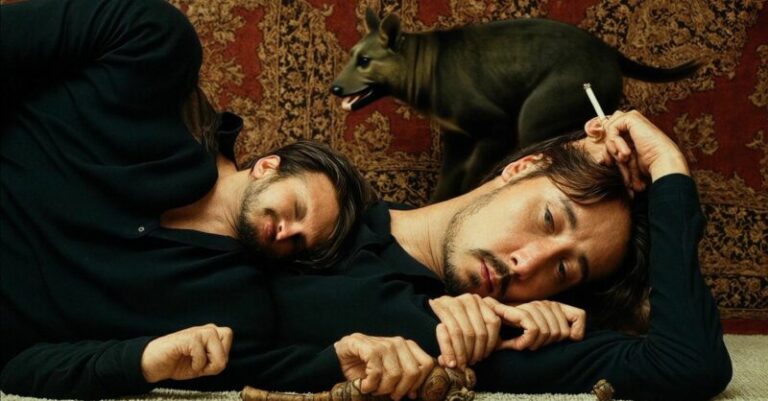
Souvenirs d’un ami (Olivier Smolders, prod. : Le Scarabée/WIP, 2025)
I also asked an AI to generate a family photo for me, to see what I was up against. You can understand its biases by looking at what it produces. The result is interesting: they’re beautiful, certainly, but they’re very white, even very fair-haired — even the dog is fair-haired.
I call that fascist, and I don’t say that lightly. The cult of the perfect body, the perfect family, normativity and the uniformity of representations – it wasn’t just anyone who wrote that: it was Mussolini. He would have loved AI, because that’s exactly what it does. This is an important point, because we’re talking about a supposedly creative tool that imposes this sort of representation on us, which is a terrible form of narrow-mindedness. I work in the world of animation and advertising, and in the 2010s, there was a real sense of a desire for inclusivity. We were starting to ask ourselves whether, in lingerie adverts, we might feature people who were a bit curvier, or whether, in group photos, we might make sure to include all skin colours. We were a long way from achieving that, but there was a growing awareness: we were trying to represent people as they really are.

AI has ruined everything. Because we have to work quickly, and because clients are demanding we use it to cut costs, we no longer have time to correct these errors. The aim is to be the first to publish the content, and the client no longer has any regard for these issues. It’s worse than we realise. All graphic designers and animators make an effort to include diversity, but clients ask for it to be removed. I’ve seen with my own eyes a client’s feedback saying: ‘No, but a female mechanic? We’re not going to go that far, are we? ’ It’s completely uninhibited. AI facilitates this, as it operates on a statistical average. As the global average is dominated by certain representations, the result is inevitably normative.
It’s all white! There are so many Swedes!
A family is more like the one you see in Jean Forest’s film, Réunion de famille.
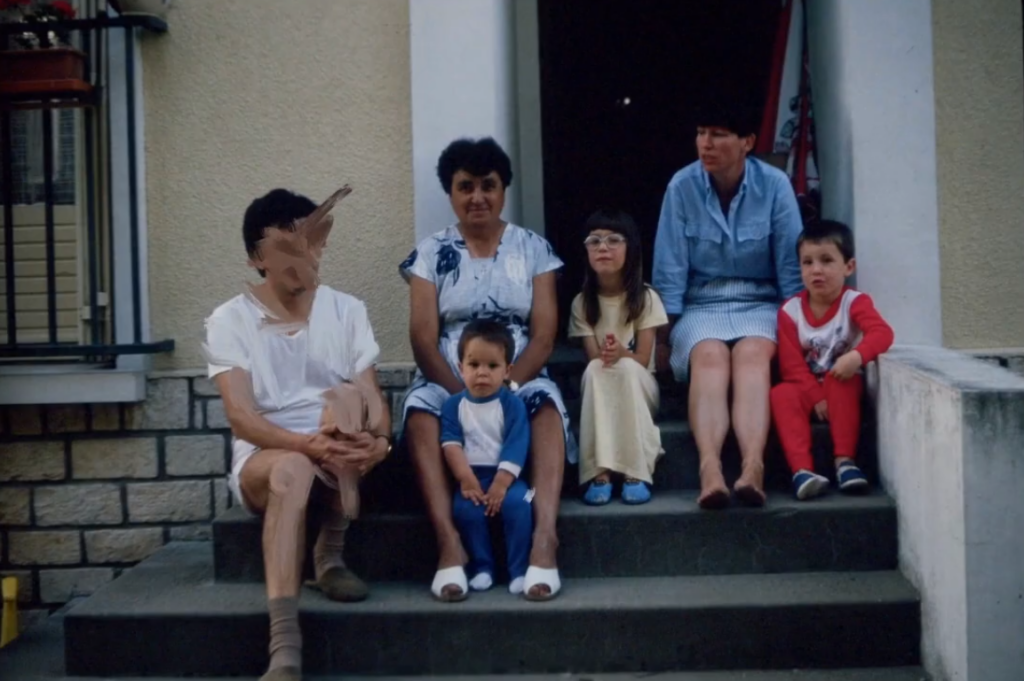
Réunion de famille (Jean Forest, prod. : Rayuela productions, Supermouche productions & Zorobabel, 2025)
There’s a real problem with this kitsch imagery generated by AI, and I genuinely see a step backwards that we won’t be able to fight against. This is no trivial matter, and the same applies to text. A study was recently published showing that simple autocomplete — the fact that AI finishes our sentences for us — alters people’s opinions. When you see what this produces, you realise it’s problematic. It isn’t necessarily a deliberate conspiracy, but AI systems are inherently biased; neutrality doesn’t exist. Even if we correct the bias towards a white family, we’ll create another bias.
To conclude with this family photo, when I asked for a ‘racialised’ family, the AI refused, claiming that I had no right to use that term. As well as being prescriptive, it censors. Why ban me from using that word? It deprives us of the language that allows us to think about the victims of racism. The war of words is important.
And it isn’t Gemini (Google) or Claude (Anthropic); it’s Adobe — the software company behind every image in the world — that has censored the word ‘racialised’. There isn’t a single image you see anywhere in the world that hasn’t been processed by Adobe software, and it is this company that has implemented this censorship. I’ll leave you to think about that for yourselves.
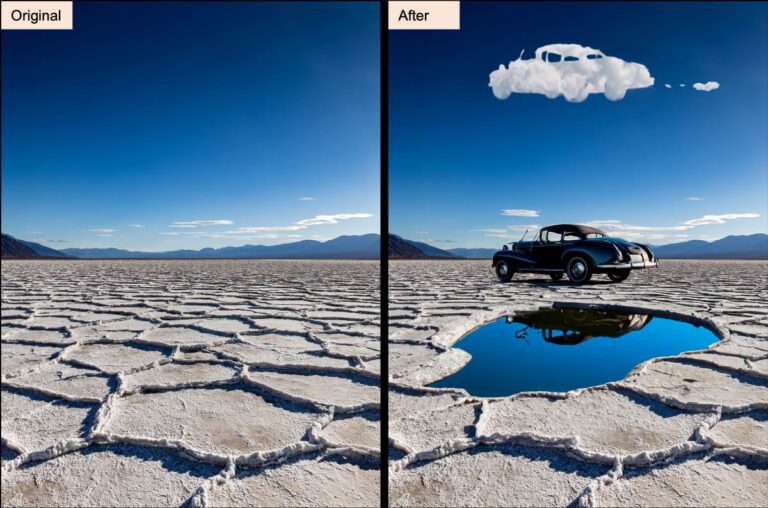
With Adobe Firefly technology, it is possible to add an element to an image in Photoshop simply by entering a prompt.
To return to a more artistic aspect, here is an example I’ve borrowed from The Hotmeal, a comic-book artist who is very successful in the United States. It is Christina’s World, a painting by Andrew Wyeth. In it, the painter depicted his neighbour, who suffered from an illness that paralysed her and caused her pain whenever she moved; he sought to illustrate this suffering through her journey from her bed to her kitchen. I’d very much like to see this painting in person, as it has a distinctive feature. For a start, an AI wouldn’t really be able to do this, as it doesn’t know how to compose outside the classical conventions to shift the focus away from the subject. But above all, the painter painted every blade of grass and every strand of hair with tiny brushes, spending an infinite amount of time on these details. Unlike an AI, which effortlessly generates ultra-detailed images, the painter spent all that time because he wanted to put himself in the same state of suffering as his subject. His creative process tells a story; it is an integral part of the work.
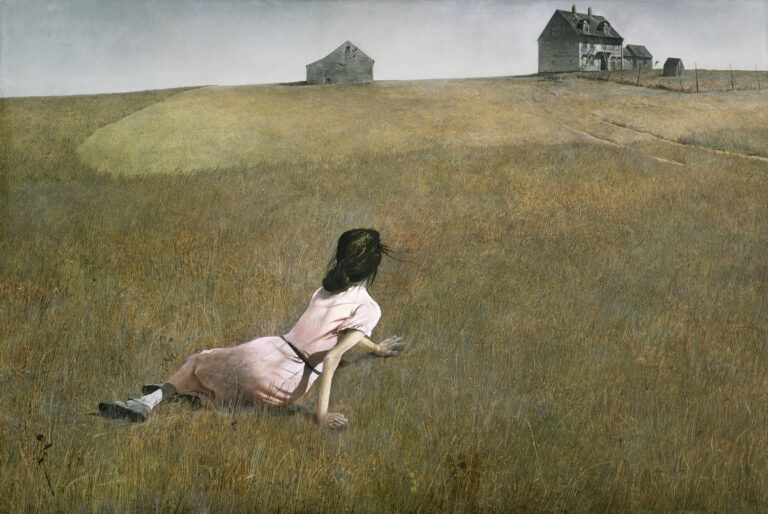
Christina’s World (Andrew Wyeth, 1948)
This is why the choice of production technique in animated film is, in itself, a narrative choice. That is why it is tiresome for those in the industry to hear that AI is going to ‘replace all jobs’. That would deprive us of an essential narrative choice: the choice of how we make things.
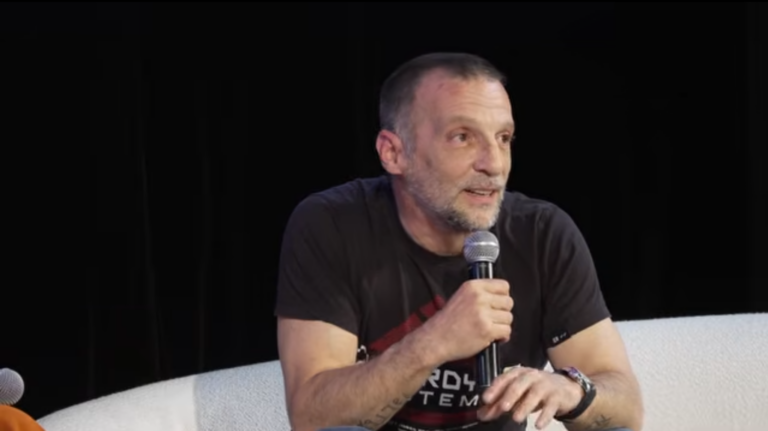
Mathieu Kassovitz at the World AI Film Festival (WAIFF) as part of the ‘Different Perspectives on AI in Cinema’ talk with Claude Lellouch
Finally, I can’t help but mention Mathieu Kassovitz. He has said that digital special effects are so pervasive in films that he no longer knows what he’s watching. According to him, when he watches a film with special effects, he doesn’t know whether the snow, the car or the stunt are real, which robs him of any emotion. I want to reply: ‘Mathieu, it’s cinema. Cinema is, by definition, an illusion.’ He uses this fallacious argument to justify the fact that he is currently directing a feature film made entirely using AI, claiming that with this technology, we are no longer dealing with ‘pretence’ but with the ‘recreation of reality’.
Ultimately, this is a worrying situation. These are influential people, whose views are listened to and amplified by media outlets such as France Culture. It’s problematic to see public figures who are supposed to champion cinema making such statements; it frightens me a little.
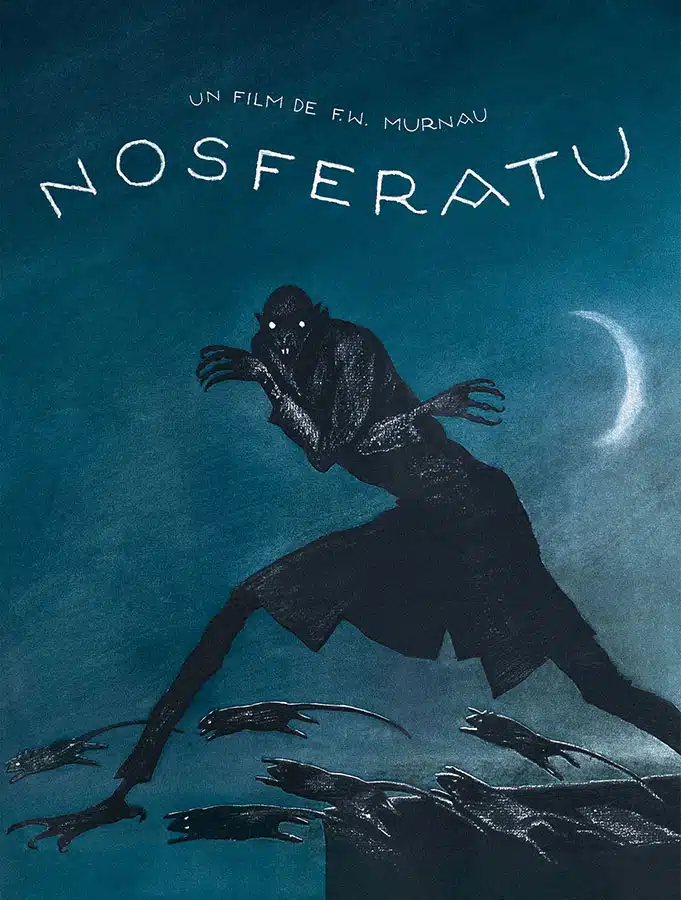
Nosferatu, Murnau (1922)
To conclude, I studied film and I teach animation. Like any student, we practise film analysis. Let’s take Murnau’s Nosferatu, released around 1920. It’s a German expressionist film in which, although it’s shot on location, everything is extremely carefully thought out and artificial. This ties in with my work as an animator: in animation, every single pixel is chosen. We create everything. There’s an intention, a narrative choice, in every detail, such as the way the hero descends a staircase from light into shadow. I love analysing these intentions. However, if I’m presented with an image created by AI, I find myself faced with a problem. As a film critic, I’m at a loss, because I don’t know where to draw the line between what is intentional and what is simply an artefact of the AI. Do we need to ask for the prompts and the ‘making-of’ details for each shot in order to understand the work?

Souvenirs d’un ami (Olivier Smolders, prod. : Le Scarabée/WIP, 2025)
That’s what I found myself wondering whilst watching Olivier Smolders’ film Souvenir d’un ami. The fact that it was created using AI is made clear, and that’s very interesting. I’m very interested in memory and the way it becomes distorted over time. Yet, throughout the film, I was torn: are the distortions in the image intentional on the part of the human, or are they random errors produced by the machine? I found it hard to make up my mind, with the feeling that the AI dilutes the human element in the film. I can’t think of any other techniques where the dilution is quite so pronounced. It’s a way of creating images that raises questions for me and which, for me, remains a grey area.
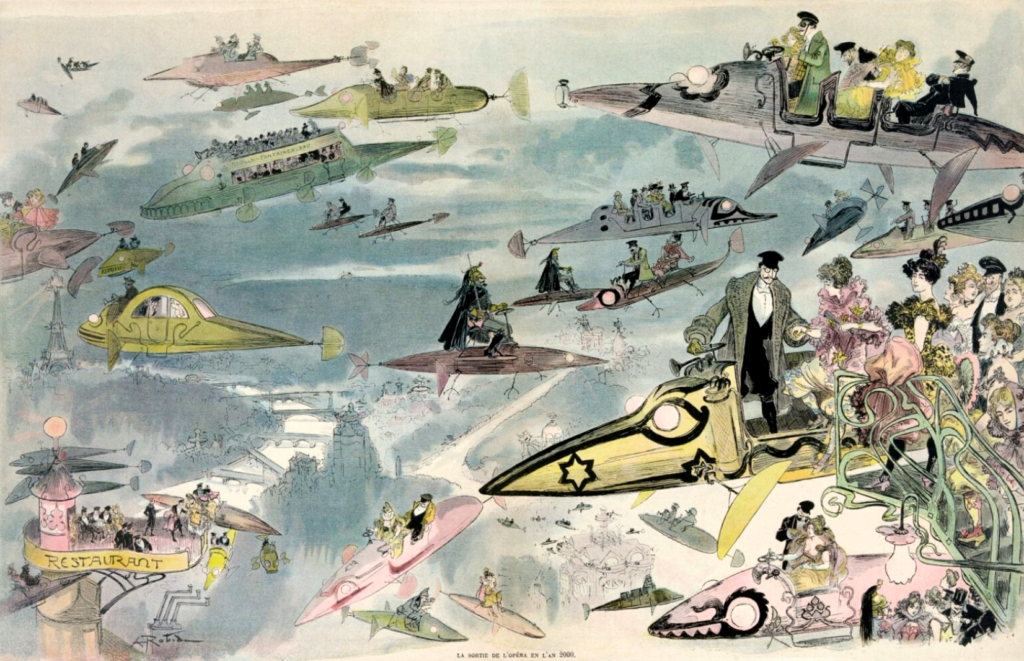
La sortie de l’opéra en l’an 2000, Albert Robida (vers 1902)
There are plenty of other topics I cover in my book and my podcast, but I’ll finish with a little story. An American scientist with a deep knowledge of physics, Daniel Whiteson (Daniel and Jorge Explain the Universe), is eagerly awaiting the arrival of aliens on Earth. He hopes they’ll be more advanced than us and that they’ll answer all his scientific questions. No, it’s not going to happen like that. So let’s imagine that an alien civilisation arrives on Earth, having travelled millions of light-years. Everyone is stunned. They’re so far ahead that they have a universal translator. They’re billions of years ahead of us. We finally ask them for their secrets: how did they achieve propulsion and interstellar travel? How does their spacecraft work? And do you know what they reply? ‘AI did it.’
Daniel and Jorge Explain the Universe: an entertaining podcast dedicated to the big, mind-boggling and unanswered questions about the Universe. In each episode, Daniel Whiteson (a physicist working at CERN) and Jorge Cham (a hugely popular online cartoonist) tackle some of the simple yet profound questions that humanity has been asking for thousands of years, explaining the science in a fun, relaxed way, free from jargon. danielandjorge.com
That’s my conclusion. And this brings me back to my point about rules in AI. That’s what worries me: fundamentally, there’s a loss of knowledge in AI.
Elliot and E.T. cosplayer, Gage Skidmore (2016)
Question from the audience: Thank you – it was a real pleasure to hear you speak and to learn so much from what you’ve shared. Given that AI ultimately has a philosophical dimension, in relation to three key aspects of our time on Earth – uncertainty, finitude and loneliness – what does it offer us?
Nicolas Dufresne: That’s a very simple question, and I’m not quite sure how to answer it. I don’t think it takes us very far on these subjects, or even on a philosophical level. I’d been hopeful. AI was created, as I said earlier, with the aim of understanding the brain. There was a scientific approach before it became a tool used by technicians in Silicon Valley; there was a desire to understand the human mind. These questions – which I haven’t mentioned because they seem to me to be off-topic, such as whether AI can have consciousness or access something else – sometimes allow us to ask genuine philosophical questions about the replication of the mind. But we must demystify AI: it remains a statistical tool, a system that works very well for what we ask of it, but it is a serious mistake to believe that there is anything behind it. It is a run-of-the-mill generator. I attach no philosophical significance to AI as such. I am interested in its impact on society, not in what it fundamentally is, as long as it does not become something else — and that’s not likely to happen any time soon.
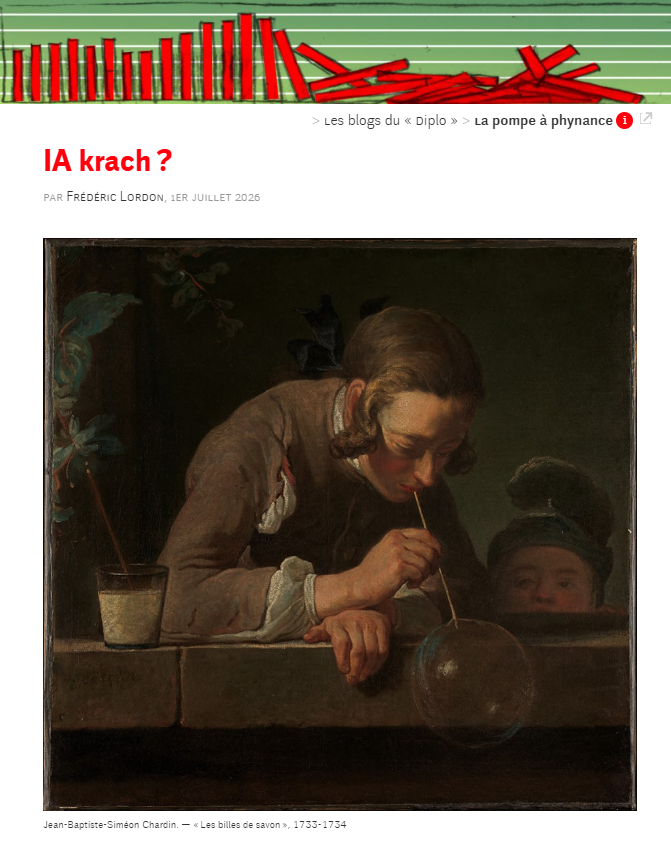
Frédéric Lordon, “IA krach ?”, Les blogs du Diplo, 1 July 2026, blog.mondediplo.net/ia-krach
In this article published on 1 July 2026 on the Le Monde diplomatique blog, economist Frédéric Lordon analyses the possibility of a financial collapse linked to artificial intelligence, fuelled by a stock market valuation bubble and a credit bubble. He highlights the critical disconnect between the astronomical investments made by tech giants and the lack of clear returns on investment, marked by growing scepticism among corporate clients in the face of soaring costs. Finally, the author explains that the erosion of collective beliefs regarding the economic potential of AI, combined with rising competition from China, could cause the sector to shift from blind enthusiasm to particularly brutal financial write-downs.
Nicolas Dufresne : I refer you to the article by Frédéric Lordon that I mentioned, as he is far more of an expert on the subject than I am. But it is true that we must understand that, in addition to their desire to make themselves indispensable, these companies are seeking to position themselves at the heart of the system. To take a less dramatic example from an animation studio, we are being pushed from all sides to use AI: by clients, by the government, which wants to justify its investments in 50-billion data centres, and even by producers who want to cut costs. Companies are adapting their production methods to these tools. When the bubble bursts, it will drag all these companies down with it, because there will be no going back: we will already have made staff redundant who have been replaced by AI, and we will already have slashed our rates. This is why the bubble is dangerous: it’s a very real threat to companies that have already started replacing humans with automated systems.
William Henne : And yes, it’s a financial bubble reaching unprecedented heights in terms of investment, even compared to 2008, and it simply cannot be profitable.
Nicolas Dufresne : hat’s impossible. This isn’t just a matter of opinion: if you look at OpenAI’s figures, their debt already runs into the hundreds of billions. To become profitable, they would need to earn enough to pay off that debt whilst continuing to operate over the next ten years. No one can objectively believe that’s possible.
Question from the audience: I’d heard, when it was first released, that the Chinese AI DeepSeek was much more efficient and used less energy. Do you know anything about this? It could offer a solution to the environmental problem.
Nicolas Dufresne: It turned out that the first version of DeepSeek was a hoax, which explains why there was less talk of it. They’ve recently released a V2 with the same claim. I don’t know whether it’s true or not, but it doesn’t make much difference: we’re facing such astronomical levels of energy consumption that simply being ‘a little less’ energy-intensive isn’t enough. We’d need to drastically reduce consumption. We’re dealing with orders of magnitude that go far beyond the simple need for reduction. Digital technology was already an environmental problem before AI; in animation studios, the National Film Centre was already requiring us to carry out carbon assessments of our computers in order to obtain grants. I wonder how they’re going to factor in AI, because as soon as an image is generated by AI, the carbon assessment becomes obsolete.
Question from the audience: Thank you for the talk; I had a good laugh, especially towards the end with the image of the family. I’m going to attempt a critique of the talk from a left-wing perspective, through a Marxist lens. On the philosophical question of what AI is capable of, my view used to boil down to this: it’s just a calculating machine, a statistical tool, and it won’t be able to think for itself. But recently, a YouTuber, Mr Phi, has shaken my convictions a little. The more we increase the power of the models, the more new possibilities are created, which is mind-boggling. However, this does not call into question my fundamental analysis: AI is merely an acceleration of capitalist society. We, the ‘cultural bourgeoisie’ in cultural production, are now discovering the instability that blue-collar workers experienced with mechanisation, automation and proletarianisation. We are in the process of becoming redundant. The fundamental critique remains that any technology developed within capitalism is aimed at acceleration for the profit of capital. Finally, on the ecological front, I would point to the rebound effect, or Jevons’ paradox, according to which improving a machine’s efficiency does not reduce energy consumption, but increases the overall use of such machines.
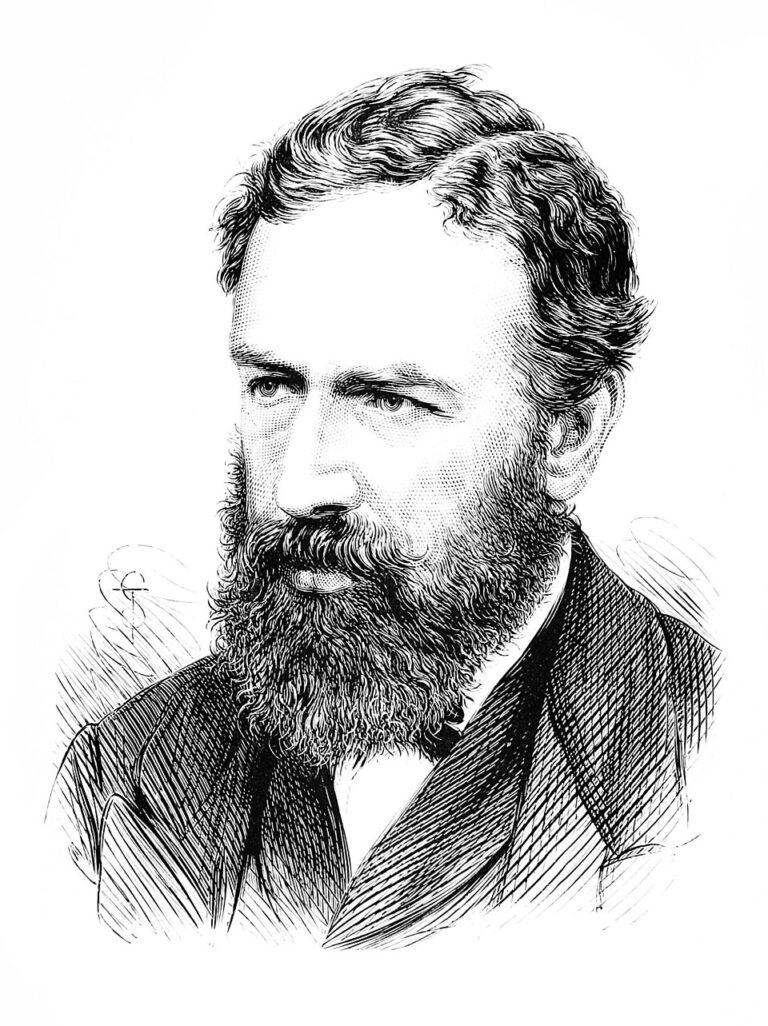
William Stanley Jevons. In his 1865 book, The Coal Question, Jevons observed that British coal consumption rose sharply after James Watt introduced his steam engine. Watt’s innovations made coal a more cost-effective source of energy, leading to the widespread adoption of his steam engine in factories. Rather than reducing total coal consumption, technological improvements and gains in efficiency led to an increase in total coal consumption, hence the paradox.
Nicolas Dufresne : That is exactly the Jevons paradox. I fully agree with your analysis of the automation of labour.
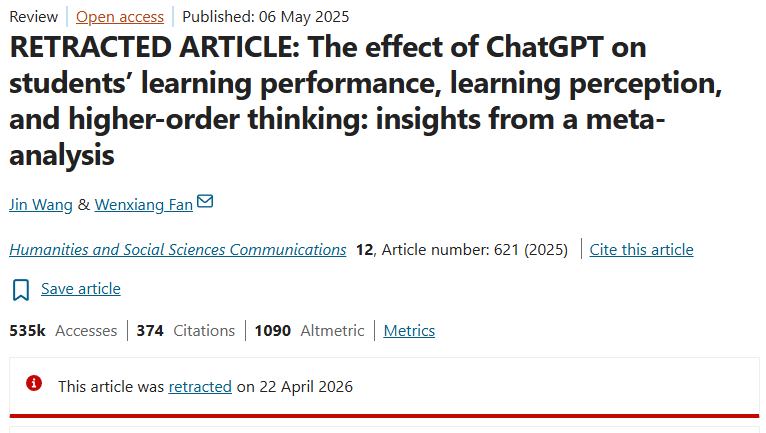
As for the cognitive capabilities of AI that some people believe in, we need to be very cautious. To come back to Mr Phi, I’m currently working on the lobbying activities of AI companies. Some time ago, Mr Phi mentioned tests applied to AI, known as ARC-AGI*. Companies are designing AI specifically to pass these tests, much like in the ‘dieselgate’ scandal, where engines were rigged to pass emissions tests without actually reducing pollution. Furthermore, these companies are consciously and deliberately using marketing techniques inherited from the tobacco industry: flooding the world with scientific studies, even those of dubious quality, to dilute genuine knowledge. We must be highly critical of articles published on archive.org that have not been peer-reviewed, or were reviewed too late, or even those published in prestigious journals such as Nature, which had to retract – a very rare occurrence – a bogus meta-study on the positive impact of AI in education. We are in the midst of the post-truth era, where scientific truth is no longer the issue. At the very least, we must maintain a diversity of opinions and be wary of anything that is too extreme, whether it is overly pro-AI or overly anti-AI. The furore will probably die down along with the economic bubble, but in the meantime, we are right in the eye of the storm.
* ARC-AGI, Abstraction and Reasoning Corpus for Artificial General Intelligence. This benchmark is designed to evaluate a program’s ability to solve simple problems in visual recognition and logic.
Question from the audience: Thank you very much for the talk. We haven’t discussed geopolitics tonight. Yet we’re constantly being told that we must be the first to master AI so as not to be overtaken by the United States or China, in the name of the arms race. To what extent is this a justification for colossal investments, or a real threat? Aren’t we repeating the same pattern we saw with nuclear power, and how concerned should we be?
Nicolas Dufresne: There are several parts to the answer. First, we can look at who is making these claims and what their interests are. Second, if we consider the environmental crisis and the economic bubble, is this really the smartest strategy? It’s not the small players who will be resilient; OpenAI will survive the bubble, but building a structure robust enough to withstand a crisis is another matter entirely. Personally, I live without a car, without a smartphone, and without AI deep in the countryside, and I’m very happy. Many countries—and even some European ones—don’t make the “AI race” a priority, and that’s okay. We need to take a step back. I’m no expert on geopolitics, and I’m more of an anti-militarist, so arguments about missile balance don’t convince me, but everyone is free to form their own opinion.
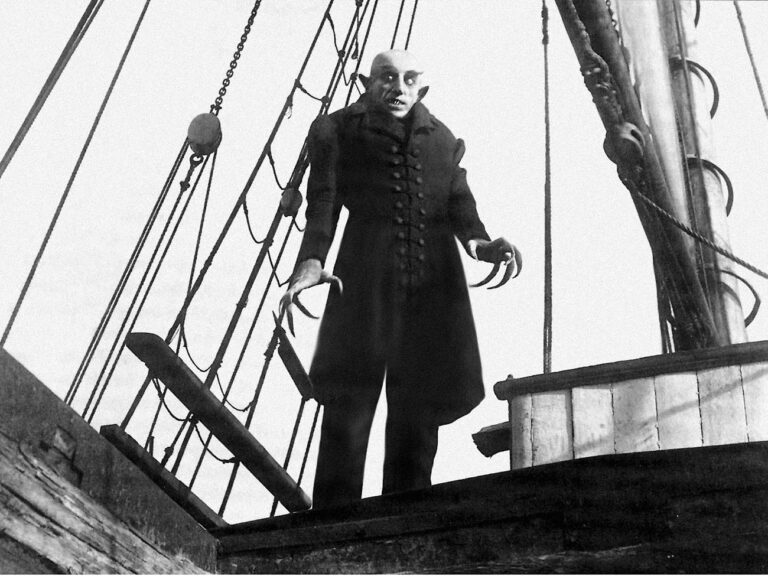
Nosferatu, Murnau (1922)
Olivier Smolders : Thank you for this talk and these insights. I’d like to return to the area where I have expertise: creativity. You mentioned that the intention of a director, a cinematographer, or a technical crew in a film like Nosferatu reassures you and creates a connection with the audience. That’s true, but it’s a perspective rooted in classical cinema. Since then, across all the arts, the question of the author’s intention has been set aside. Similarly, in literature, we ask what the text says rather than what the author meant to say. I get the impression that all of us—myself included—instinctively recoil from an image produced by AI, under the pretext that there is no intention behind it. Yet an AI-generated image in a film is the result of a series of technical and aesthetic choices. Don’t we have an intuitive reflex to reject it so as not to be seduced by a machine?
Nicolas Dufresne: It’s clear that we have this deep-seated reaction of rejection. That said, coming from the world of animated film, we have the unique advantage of creating everything from scratch, which leads us to think long and hard about every choice regarding lighting or staging to maintain narrative coherence. When it comes to using AI, I’m concerned—especially for my students—about the introduction of uncontrolled elements that could undermine their intended message without them even realizing it. Above all, within the context of the culture industry as defined by Adorno and the Frankfurt School (we’re feeling very neo-Marxist tonight), aside from the auteur cinema movement, of course, AI is marketed under a demand for speed that prevents us from taking the time to reflect on what we’re doing. That, to me, is where the fundamental problem lies, and that is also the source of my rejection of it.
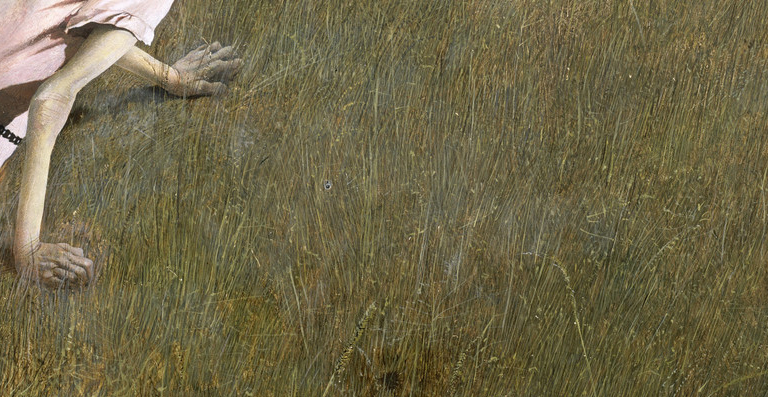
Christina’s World (Andrew Wyeth, 1948 – detail)
William Henne : In animated film, we love the hard work; the audience loves to see the effort. There’s a certain romanticism to it. It’s a bit like that 1948 Wyeth painting we saw earlier: he painted every single blade of grass with a brush made of horsehair. There’s a certain romanticism in identifying with the hard work that must have gone into it.
Nicolas Dufresne: Yes, that’s right. There’s also an admiration—even if we don’t want to admit it—for the ability to create the piece. And if it’s easy, it loses its appeal. Does it lose its appeal if it’s easy? It turns out that’s the case when we look at it. People are disappointed if an image was easy to make. It loses some of its appeal, especially when it’s hyper-polished like what AI produces. The paradox is that AI gives us an image that’s technically perfect. The family photo, for example, is beautifully lit, there aren’t six fingers, everything is perfect—and perfectly white. That perfection loses its appeal if it wasn’t difficult to create.
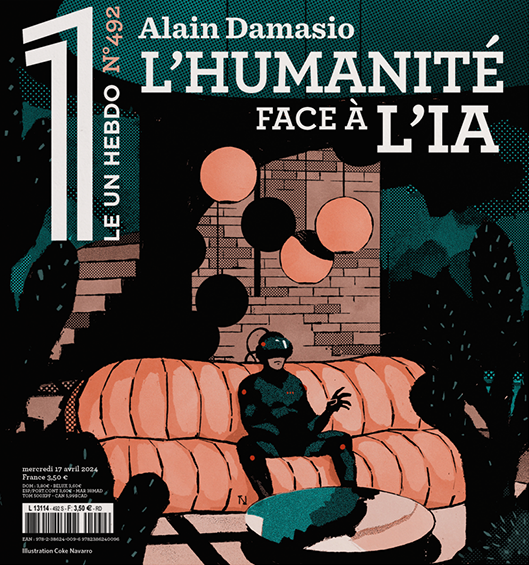
Question from the audience: Thank you for the conference. I heard Alain Damasio speak about a year ago. He was working on the topic of AI and came across a novel written by an AI. He read it and said, “Wow, I kind of feel like I wrote it myself.” He was reflecting on what that implies for art and creativity. On the other hand, there’s a widespread willingness to relinquish control over the creative process. For example, many students produce entire sections of their theses using AI. Professors are trained to spot it, and everyone wastes time. It’s ridiculous. The question is: why? We’re in such a selective system that we feel we have to conform to the norm, and this standardizing system seems ideal for that. We need to find a way to celebrate singularity—what isn’t polished. It feels like we’re not succeeding at all. I often show my students films from the 1970s with slightly “gritty” images. It’s fascinating because today, we no longer see that kind of imagery; everything has been smoothed out. We’re fascinated by smooth images.
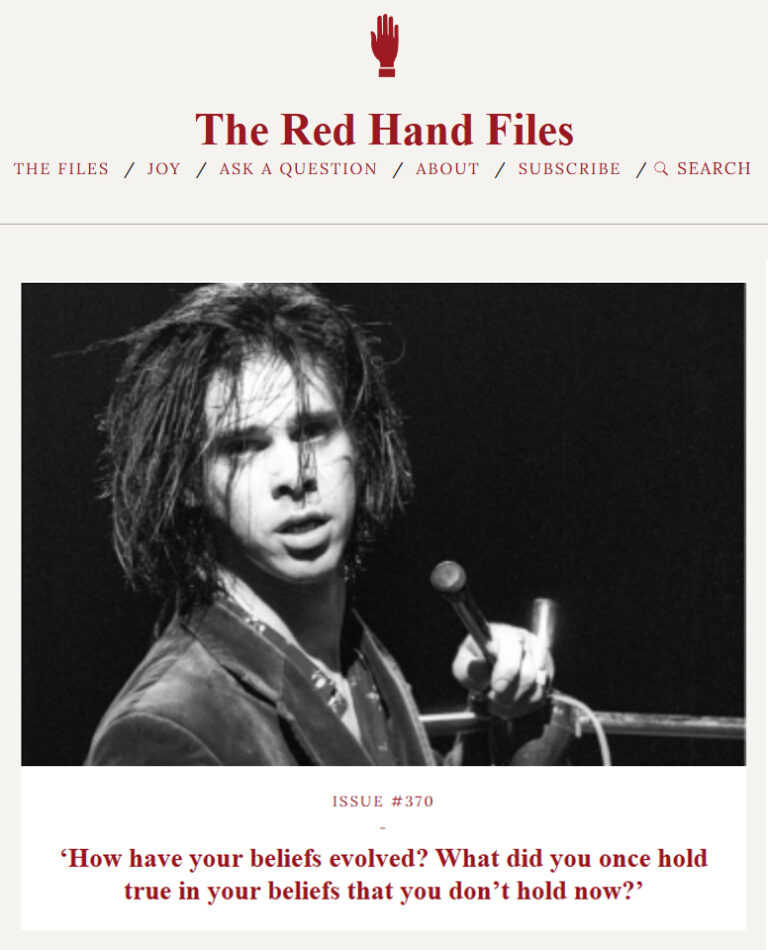
Nicolas Dufresne : Yes, and that’s incredibly normative. It’s incredibly important. I don’t really have an answer, but as far as Damasio is concerned, I find it interesting. Nick Cave, the Australian singer, faced exactly the same problem. He received a song written by ChatGPT that imitated his style. He posted a very insightful response on his blog, The Red Hand Files. First, he immediately sees that it’s not Nick Cave; he’s not fooled. Then he comes back to this idea of hard work: for him, a song is the result of suffering, and what gives it value is also the fact that someone created it. It’s very abstract because, in reality, we won’t be able to tell the difference, but knowing that makes a difference.

La bête est morte, Edmond-François Calvo & Victor Dancette (Éditions G.P., 1944)
William Henne : There are a few creators who are embracing AI with a genuine reflection on the algorithm and what it can produce, and who are creating things that are absolutely relevant. It won’t be a Mathieu Kassovitz film, I think, but maybe he’ll make a film that takes a fairly straightforward approach to using the tool.
Nicolas Dufresne : He wants to make a movie about rabbits waging war against the big bad wolf during World War II—with the big bad wolf representing the Nazis. Filming rabbits was too complicated; he wouldn’t have been able to do it without AI.
William Henne : It’s based on the comic book by Edmond-François Calvo and Victor Dancette, La bête est morte, published in 1944.
Nicolas Dufresne : It’s going to be great. I can’t wait to see it in theaters!
William Henne : Thank you very much, Nicolas. Did Yann want to say something?
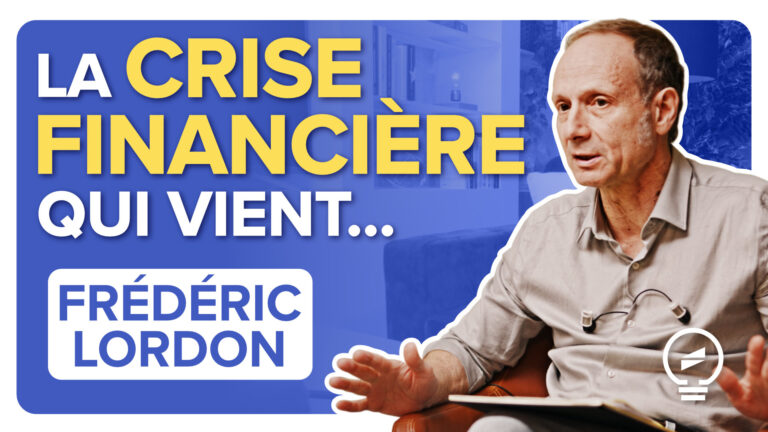
Yann Bonin : Thank you all for coming. For those who find it difficult to read Frédéric Lordon in Le Monde diplomatique, please know that he often explains his writings in videos. Following the study on the AI financial bubble, if you go to the elucid.media website, he explains it all there in a way that’s easier to understand. Thank you again.
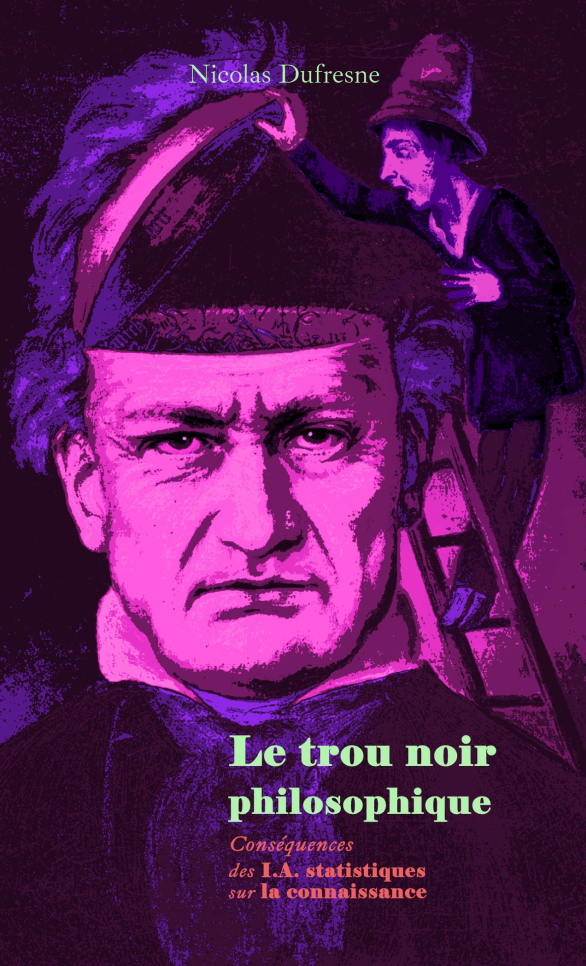
Nicolas Dufresne – Le trou noir philosophique. Conséquences des I.A. statistiques sur la connaissance